Many U.S. traders assume that “logging in” to an exchange is a low-skill, purely mechanical step: enter credentials, click submit, trade. That misconception hides two important facts. First, OKX presents a blended product set — a centralized exchange, a non‑custodial Web3 wallet, and a DEX aggregator — so the act of signing into an OKX account is also a decision about custody model, regulatory identity, and which security surface you expose. Second, the interface you choose (web, mobile, or browser extension) changes the threat model and the operational trade-offs: convenience versus exposure, speed versus absolute ownership.
This piece compares the practical alternatives you face when an American trader wants to use OKX, clarifies the mechanics behind the login and account types, and gives concrete heuristics for when each path is appropriate. I’ll also highlight a recent operational change you should be aware of and name the most important safeguards to reduce the kinds of losses that matter in practice — not hypotheticals but the everyday failures traders actually experience.
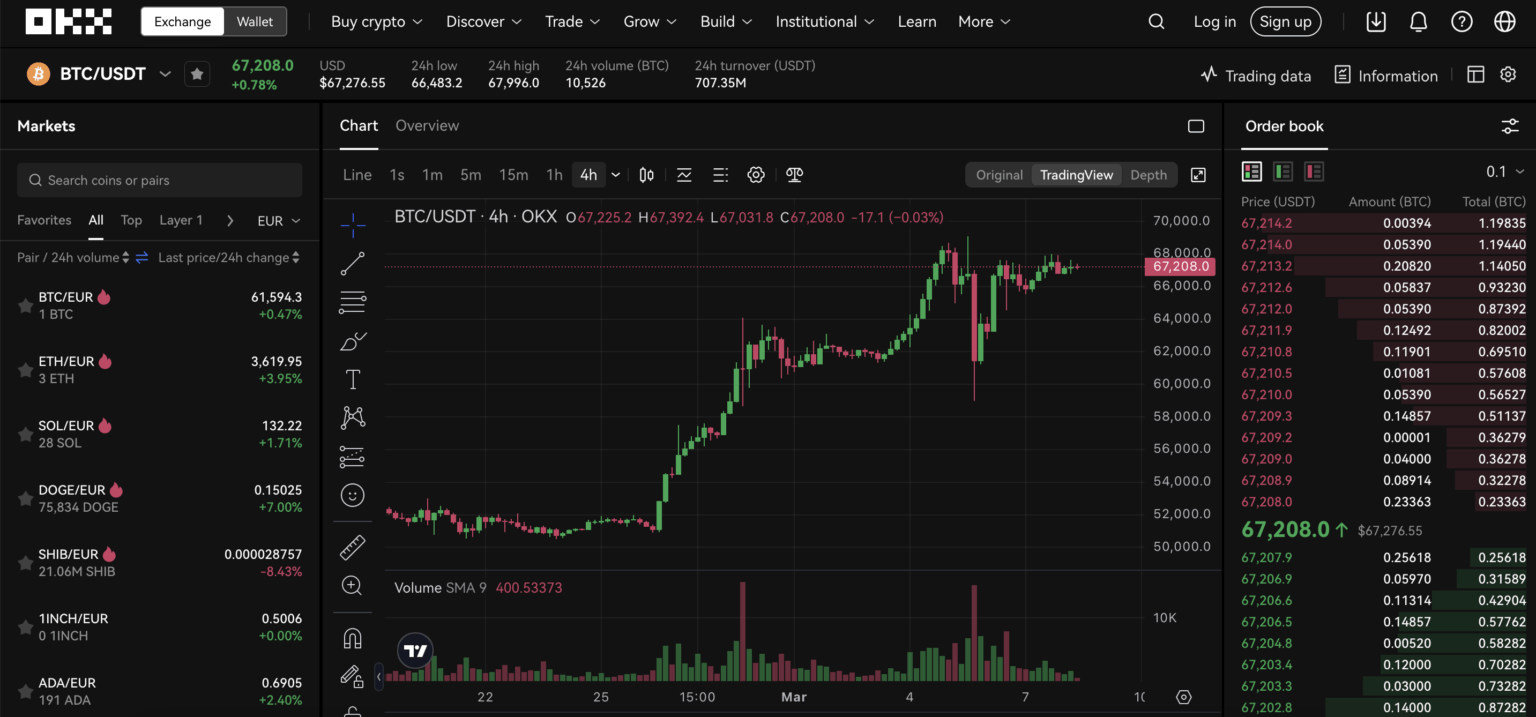
Two login worlds: CEX account vs non-custodial Web3 wallet — side‑by‑side
At the highest level, logging into OKX leads you to one of two regimes. The first is the centralized account (CEX): you pass KYC, hold assets on exchange-managed custody, use exchange orderbooks for spot, margin, and derivatives, and depend on OKX’s cold storage and PoR transparency for systemic safety. The second is the OKX Web3 wallet: you retain private keys or connect hardware wallets, sign on-chain transactions yourself, and use the DEX aggregator or dApps. Which is “better” depends on what you value — counterparty risk reduction and custody for high-frequency derivatives trading, or absolute key control for DeFi and NFT ownership.
Mechanics and trade-offs, briefly:
– KYC CEX login: identity verification (government ID + liveness check) is mandatory for fiat rails in the U.S. This unlocks spot, margin up to 10x, futures, options, and high-leverage perpetuals (up to 125x on some instruments). The trade-off: you accept custodial risk (albeit mitigated by >95% cold storage and multi-sig withdrawals) and regulatory visibility.
– Web3 wallet login: your “login” is seed‑phrase or hardware wallet connection; no KYC required for purely wallet interactions. The trade-off: you avoid custodial counterparty risk but take on seed‑phrase loss risk and DeFi smart-contract risks. There is no exchange intervention if you lose keys or fall victim to a phishing site.
How login methods change your trading choices
Which login you use materially alters your available products and the cost profile of mistakes. For example, derivatives like quarterly futures and leveraged perpetual swaps are exclusively on the exchange side; you need a verified OKX account and the appropriate margin settings to access them. Conversely, using the Web3 wallet opens the DEX aggregator that sources liquidity across Uniswap and other AMMs for cross‑chain swaps — useful when a token is delisted on the CEX or when you prefer to trade directly from a self-custodial address.
Practical implication: if you are an active trader who needs low latency, advanced TradingView charting, and margin/futures, the CEX route makes sense despite custodial trade-offs. If your priority is managing NFT collections, interacting with Arbitrum or Optimism dApps, or preserving on‑chain anonymity, the Web3 wallet is the right login method.
One recent operational note that matters: OKX routinely prunes low-volume trading pairs. In mid‑March 2026 the exchange delisted several small spot pairs as part of routine housekeeping. That kind of delisting is normal, but it underscores a decision point: if you keep a marginal token only because you want to HODL it, storing it in a self‑custodial wallet removes delisting risk; if you need exchange liquidity for fast exits, be ready to move assets before pairs are removed.
Security mechanics — what login security actually buys you
OKX layers technical protections that matter in practice: military‑grade encryption, AI threat detection for suspicious logins, and mandatory two-factor authentication (2FA) by SMS, Google Authenticator, or biometrics. Those systems reduce automated account takeover and replay attacks. However, they do not eliminate user-level failures: phishing pages, reusing passwords, or misconfiguring 2FA remain the leading causes of loss. A critical nuance — AI threat detection flags anomalous behavior but cannot read your mind: if you approve a withdrawal or paste a seed phrase into a malicious site, platform security cannot reverse that action.
Another boundary condition: Proof of Reserves adds systemic transparency that helps verify backing for user deposits, but it does not prevent all failures. PoR shows on‑chain holdings, not counterparty solvency under extreme market stress or hidden off‑book liabilities. In short, PoR raises the floor but it isn’t a guarantee of uninterrupted service in every market shock.
Decision framework: which login to use, in three heuristics
Heuristic 1 — Liquidity and execution needs: Use the CEX login when you need immediate execution on centralized orderbooks, margin, or derivatives. Heuristic 2 — Custody sovereignty: Use the Web3 wallet when you require absolute control of keys, want hardware wallet integrations, or need to interact with DeFi primitives. Heuristic 3 — Mixed workflows: Use both, but segregate use-cases: keep a trading balance in the CEX account sized for expected volatility and keep long-term holdings or sensitive NFTs in the non‑custodial wallet. Segregation reduces blast radius from phishing or margin calls.
Practical tip: never move your entire portfolio across models in the middle of a stress event. During fast drawdowns, exchanges may temporarily widen spreads or alter margin requirements; self-custodial transfers during congestion can be expensive and slow. Plan the migration window in calm markets.
Operational checklist before you log in
– Verify the URL and use bookmarks. Phishing pages mimic OKX interfaces; a browser bookmark reduces risk. – Enable hardware-backed 2FA and avoid SMS if possible. – For Web3 wallet use, secure your seed phrase offline and verify hardware wallet firmware before connecting. – Keep small exchange balances for active trading and larger holdings in cold storage or self‑custody. – Monitor delisting announcements and move less-liquid tokens ahead of scheduled removal.
For step‑by‑step account access or the official OKX login flow, visit the exchange’s account portal directly; many traders bookmark that entry point to avoid spoofed pages. A useful entry resource you can follow is this direct OKX login guide: okx.
Where this breaks: limits, trade-offs and real uncertainties
There are limits to what login protections can do. Regulatory pressure can change account features regionally — U.S. users already face stricter KYC and asset availability constraints compared with other jurisdictions. Delistings, like the recent removal of small spot pairs, are a reminder that exchanges optimize liquidity and compliance, not your sentimental holding. Smart contract risks and DeFi exploits remain an unresolved source of loss when you move assets out of custodial control: code is fallible and audits are partial signals, not guarantees.
Another uncertainty is how firms will balance on‑chain transparency with business confidentiality. Proof of Reserves improves trust, but it is possible exchanges adjust operational practices (e.g., custody split strategies, liquidity sourcing) in ways that change user experience without immediate public signals. Watch announcements, but also watch behavioral signals — spreads, orderbook depth, and the timing of maintenance windows — for earlier signs of stress.
What to watch next (conditional signals, not predictions)
– Market microstructure: sudden shrinkage in orderbook depth on major pairs, or systematic widening of spreads, is a leading indicator of execution risk. – Delisting cadence: if delistings accelerate, expect tighter listing standards and an expanded role for cross-chain swaps to access tokens. – Wallet tooling: improvements in hardware wallet UX and browser extension security would lower the cost of self-custody and shift more activity off central orderbooks. Each is a conditional scenario: none is guaranteed, but each is plausible and actionable.
FAQ
Q: Do I need to complete KYC to log in and trade on OKX from the U.S.?
A: To use fiat rails and most centralized trading features in the U.S., yes — OKX requires KYC (government ID + facial liveness check). You can still interact with the non‑custodial Web3 wallet without KYC, but that path excludes centralized margin and derivatives.
Q: Which login method is safest against hacks?
A: Safety depends on the failure mode. CEX accounts offer operational protections (cold storage, multi‑sig, AI detection) that reduce exchange hacks, but they carry custodial risk. Self‑custody eliminates exchange counterparty risk but makes you solely responsible for seed security and vulnerable to phishing. The safest operational posture is separation: keep trade liquidity on the exchange and long‑term assets in hardware‑backed self‑custody.
Q: If a token is delisted on OKX, can I still trade it via the DEX aggregator?
A: Often yes. The DEX aggregator sources liquidity across multiple AMMs and chains; delisting on the centralized orderbook does not remove the token from decentralized markets. However, DEX liquidity may be thin and transaction costs higher, so plan accordingly.
Q: How does Proof of Reserves affect my decision to keep funds on OKX?
A: PoR increases transparency about on‑chain backing, which reduces some counterparty concerns. But PoR does not eliminate all operational risks (market stress, off‑book obligations). Use PoR as one input among custody guarantees, insurance coverages, and your personal risk tolerance.